
Item Code: kartina-72
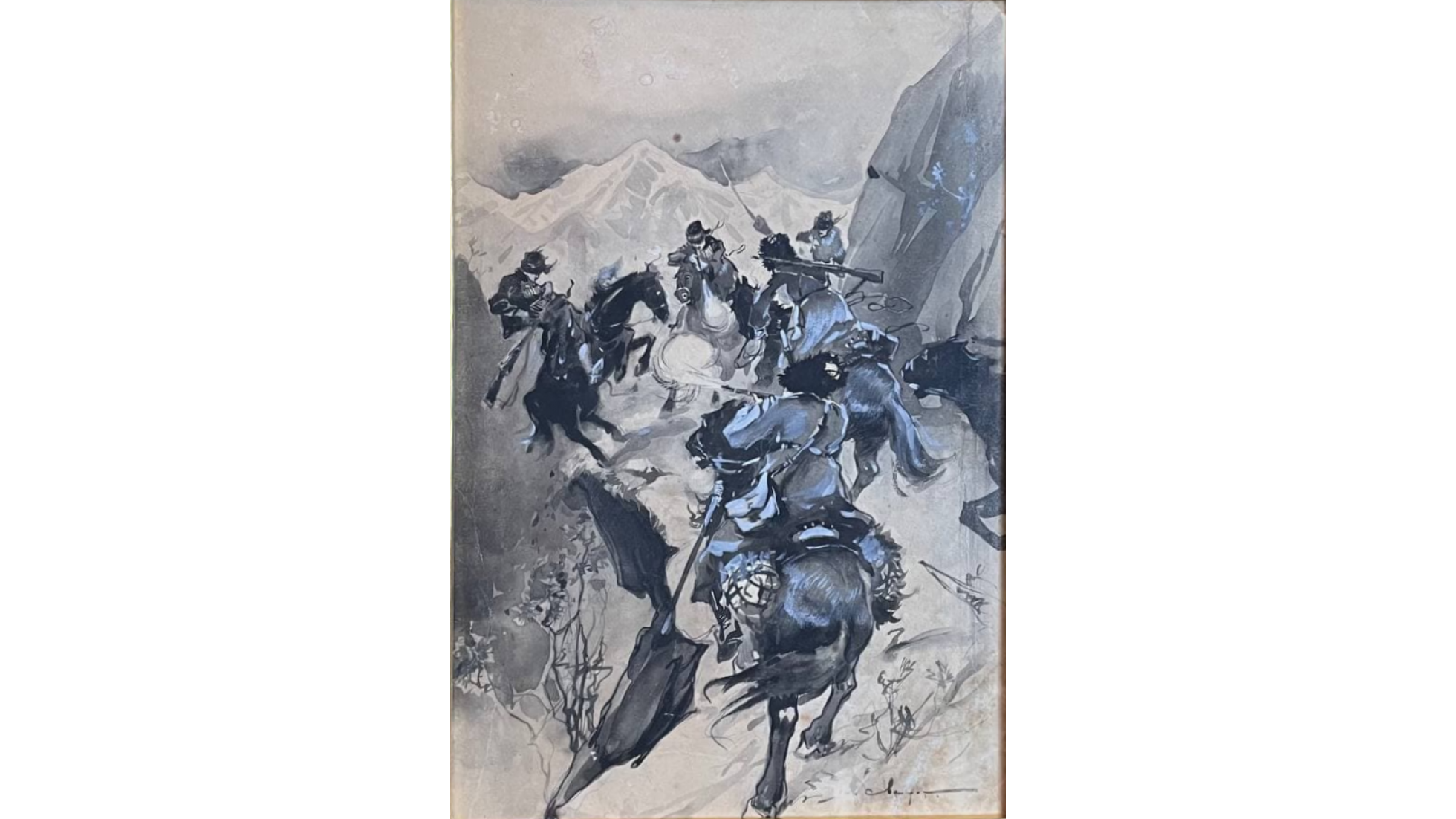
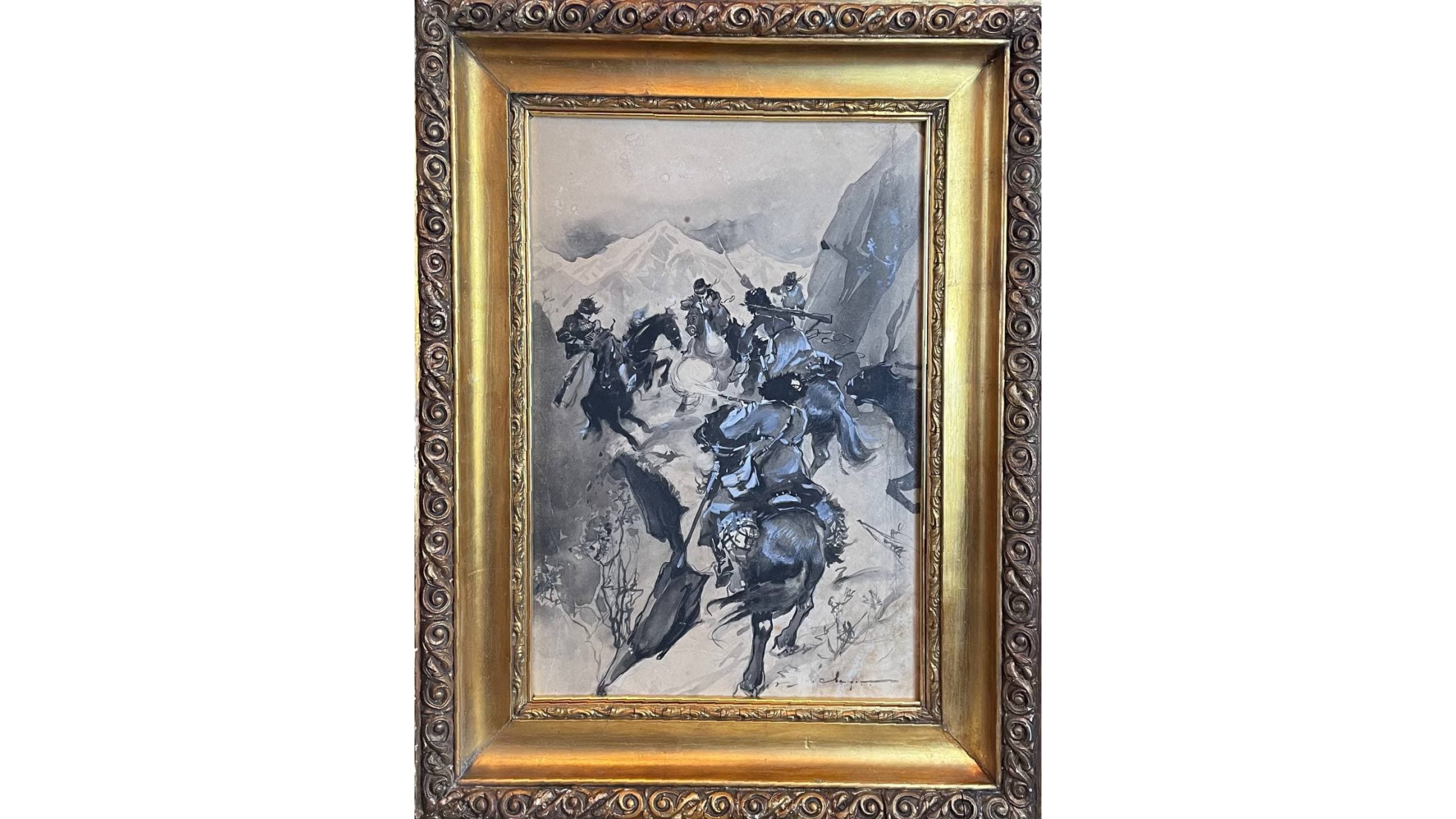
"Skirmish on the pass"
Author: Vasily Semyonovich Svarog (1883-1946)
paper mixed. tech. 47 x 35 cm
V. S. Svarog (real name — Vasily Korochkin) was born in Staraya Russa on March 18, 1883.. Korochkin's artistic talent, coming from a peasant family, was noticed even during his studies at the parish school...
From Staraya Russa, thanks to the participation of one of the teachers of the school and P. P. Chistyakov, with the money collected by a subscription list among representatives of the intelligentsia, in 1895 he went to St. Petersburg, to the art school of Baron Stieglitz. Here the young man chose a new name for himself — the Slavic pagan god Svarog. After graduating from college in 1902, Svarog worked a lot in the genre of landscape and portrait. However, his most famous works of the pre-revolutionary period are associated with posters and magazine, mostly satirical, graphics.
After the October Revolution, in 1919, the artist returned to Staraya Russa, where he became the initiator of many initiatives in cultural and educational work. He organized the People's House, created an amateur opera group, did a lot to open an art gallery in the city, on the basis of which a local history museum was later organized.
Later, Svarog moved to Moscow. In the 1920s and 1930s, he published numerous drawings in Leningradskaya Pravda, Krasnaya Gazeta, then in Pravda, Izvestia, Komsomolskaya Pravda and other publications. The artist performed portraits of V. I. Lenin, I. V. Stalin, their closest associates, shock workers, displayed the life and exploits of the Red Army, national celebrations and festive meetings, created compositions on industrial and collective farm subjects.
All this largely determined the thematic repertoire of Svarog's paintings, especially after his entry into the Association of Artists of Revolutionary Russia in 1925.
His works of revolutionary and historical content, praising the Soviet system, are distinguished by a wide variety of themes, genres and images. He created a whole gallery of portraits of figures of the Communist Party and the government.
Having excellent professional training, Svarog, like many other engaged artists, created with great success in officially discouraged genres. He painted lyrical everyday compositions ("The Shepherd Boy", 1938), expressive landscapes ("The Sea, calm", 1939), exquisite still lifes ("Different Glass", 1934), chamber portraits ("Portrait of a Woman", 1923 "Mother and Sister", 1926 "Self-portrait", 1926.).
At the posthumous exhibition in Moscow in 1946, about 300 paintings of the artist were presented. Over 180 drawings, watercolors, canvases were donated to Staraya Russa by Svarog's relatives. Now one of the streets of Staraya Russa is named after the artist.
Svarog's works are kept in the State Museum of Fine Arts, the State Museum of Fine Arts, and in many state art collections in Russia and neighboring countries.
80 000.00 грн.
- Availability: In the gallery 1