
Porcelain
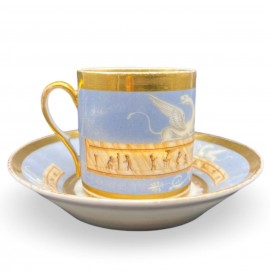
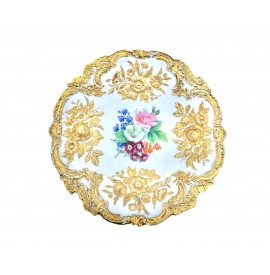
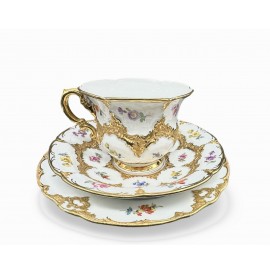
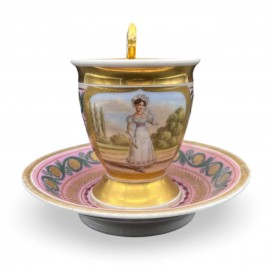
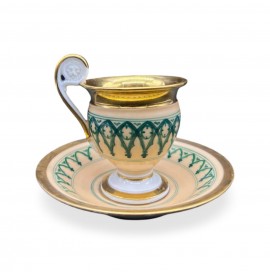
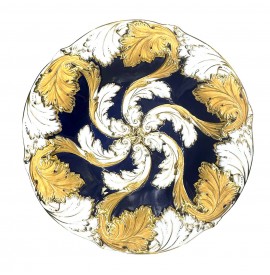
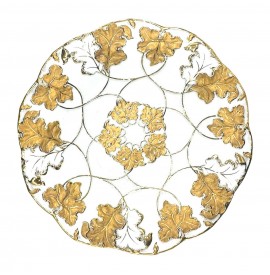
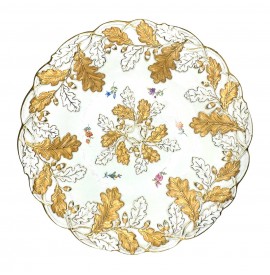
Porcelain is the noblest and most perfect kind of ceramics. Its value and significance is evidenced by the origin of the word - "fagfur", which meant the title of the Chinese emperor among the Arabs and Persians. The magical properties were attributed to porcelain products, and many legends surrounded it. In Iran and India, it was believed that porcelain dishes would change color if poisoned food was put into it. Among European monarchs and their entourage, the fashion for collecting Chinese ceramics began in the 13th century. Porcelain dishes were carefully kept in treasuries, they were set in gold by the best jewelers and were a matter of special pride for their owners.
Hard porcelain appeared in China during the reign of the Mongol Yuan dynasty and was the result of a long development and improvement of ceramics. For several centuries, before the invention of porcelain in Europe, China was a monopolist in its production. For a long time, along with the production of silk, porcelain remained one of the most forbidden and desired mysteries of the East. The secret of its production was cherished like the apple of an eye.
The period of great upsurge in the history of feudal China was the first half of the Tang dynasty. At this time, there is a brisk trade in the South of China. It is also customary to associate the flourishing of porcelain production with this period. China's trade links with Western Asia and Europe were carried out along the "Great Silk Road". Along the sea route, one ship could transport 50-60 thousand porcelain items all the way to the Indian Ocean and North Africa.
According to the Chinese, porcelain should be white, identified with snow, or blue, like the sky, washed by rain. The greenish color of the shard was also considered acceptable. In addition to color, porcelain should be as resonant as a gong, transparent as glass, thin as a sheet of paper, and strong as metal.
Each dynasty and ruling house left its mark on the development of porcelain production. The methods of firing, the composition of the mass and types of decor were improved, only the quality and high artistic value of the products remained unchanged.
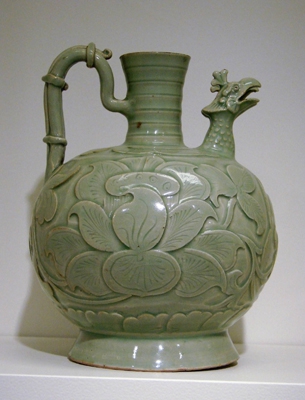 The earliest porcelain items were elegant, elongated, polished jugs. Blue and especially valuable pale green vases with embossed ornamentation, which in Europe are called celadon. Later, products in a displaced pattern and vessels of the color of the sea wave began to appear. The Chinese used cobalt and hematite as paints that could withstand intense heat, since finishing with enamel paints began to be used only in the 17th century.
In 1298, the famous traveler Marco Polo first told Europeans about porcelain - elegant dishes made of transparent white material. He brought home the first sample of such items - a white porcelain vase, which is kept to this day in the San Marco Treasury in Venice.
Chinese porcelain reaches a high degree of perfection in the 15th-16th centuries. It was porcelain of this period, decorated with lead glazes of three colors (sancai) or underglaze blue painting, which was often combined with overglaze painting, produced in large quantities, that got to Western Europe, where it immediately attracted Europeans with its technical and artistic perfection, extraordinary richness of forms and decor.
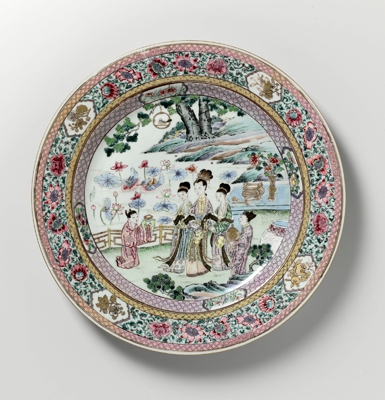 The production of porcelain in China has always had two directions - export, which was a large source of income for the state, and domestic, for the needs of the imperial court and the nobility. These directions significantly differed from each other both in form and decoration. For example, by order of the emperor, 31,000 dishes, 16,000 plates with dragons, 18,000 cups were produced annually. And for Europe, luxurious vases, ceremonial dishes and sets were required, which were not so much used as they were put on display as outlandish jewelry that raised the status of their owner. Especially famous are the products made during the reign of the Kangxi emperors (1662-1722) and his grandson, the Qianlong emperor (1711-1799), which were distinguished by a particularly lush, polychrome decor and received the names of the green family, the pink family, and the yellow family. In these products, named for the predominance of the corresponding tone, they were attracted by the refinement of forms, the purity of the surface.
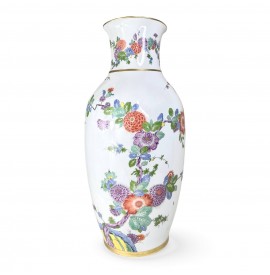
At the beginning of the 16th century, the secrets of the porcelain production technology became known to Japanese masters. At first, the porcelain of the Land of the Rising Sun was much inferior in quality to classical Chinese products. But he was famous for its luxurious decor. The plots and patterns presented were distinguished by a significant variety, bright colors and real gilding.
In 1516, the Portuguese crossed the raging ocean and landed in China for the first time. The explorer and navigator Rafael Perestrello was received at the port by the Chinese rulers with permission to trade with merchants, but he was strictly forbidden to move further inland. Still not knowing its name, the navigator bought 100 thousand outlandish items from porcelain.
After 8 years, the king of Spain issued a decree according to which the share of porcelain on all merchant ships returning from the East should have been at least one third of all goods. When the first products came to Europe, the price for them was prohibitively high. But the demand for porcelain was enormous, so many merchants, at their own peril and risk, went to China for "white gold", as porcelain was then called.
Missionary activity of the order of the Jesuits of the Roman Catholic Church, Dominican and Franciscan monks began in the 17th century. Missionaries reported to the Vatican and other spiritual orders.
In 1712 and 1722, the French priest Francis Xavier Dentracolles, who lived for seven years in the city of Jingdezhen porcelain production, sent letters to the Jesuit community, in which he not only talked about the Chinese economy, politics, culture, traditions, customs and customs, but also discovered the principles of molding. technologies for creating porcelain blanks, painting methods, as well as features of firing products. At the same time, on the other side of the world, the alchemist Betger was approaching the solution to the creation of porcelain.
You can see and purchase wonderful works of Chinese and Japanese porcelain by visiting the Vernissage Gallery.
Germany
Among the passionate admirers of porcelain was the Saxon king Augustus II, who devastated the royal treasury due to this enthusiasm. It is not surprising that, upon hearing of a young alchemist who claimed to be converting mercury into gold, the king ordered Friedrich Bötger to be brought to Dresden and put under surveillance there. In 1704 he was assigned to the physicist and mathematician Hrenfried Walter von Chirnhaus, who conducted extensive geological research in Saxony. After unsuccessful attempts to mine gold, in response to threats from Augustus the Strong, Bettger volunteered to establish a hard faience manufactory, and in 1707 he was provided with the necessary funds. The fruitful joint work of an old scientist and a capable young man ultimately leads to a solution to the question of the required composition of the porcelain mass.
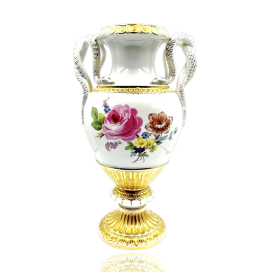
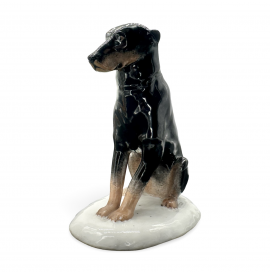
In January 1710, the first European hard porcelain manufactory was launched at the Albrechtsburg castle in Meissen. Europe instantly fell in love with fragile porcelain. Meissen porcelain owes much of its fame to the artist Ioan Gregor Herold, who invented the decor of seemingly fresh flowers, and the sculptor fashion designer Johann Joachim Kendler, who created incredibly naturalistic figures of animals, birds, charming small figurines and sculptural groups in the rococo tradition. Kendler's creative genius also owns the first examples of ceremonial porcelain sets in Europe, which are characterized by splendor and richness of decor. Together with Kendler, the sculptor Michel Victor Asier worked, who introduced the ideas of classicism into Meissen plastic, which he brought from his French homeland.
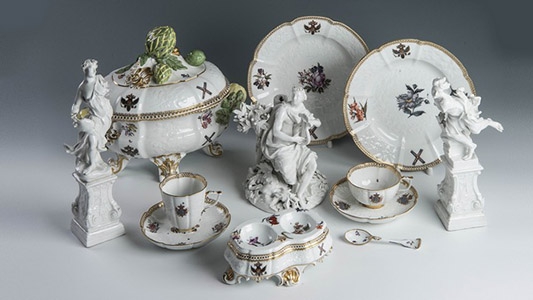 As a rule, Meissen dishes were painted with images of animals and birds, portraits, everyday sketches, which captivated the audience with the exquisite tenderness of colors. The royal manufactory produced luxurious floor vases, figurines, various vessels, toilet and writing instruments, snuff boxes, and later - clock dials. Sculptural groups and animal figurines were very popular. But the Meissen masters especially succeeded in "gallant festivities" - scenes representing the refined entertainments of aristocrats. These are amazing compositions with witty plot solutions, danceable ease of characters' movements, and swift action. They amaze with the fullness of life, harmony of feelings and refinement of form.
Even in the first years of the existence of the Meissen manufactory, its superintendent Johann Melchior Steinbrück realized the need to protect real Meissen porcelain from counterfeits and imitations. On November 8, 1722, he proposed using the underglaze mark of the crossed cobalt swords that were part of the coat of arms of the Saxon Electors as the hallmark of Meissen porcelain. This is how the famous "Blue Swords" appeared - a trademark of the manufactory, which is applied to every porcelain product, it is the oldest and longest used trademark without interruption.
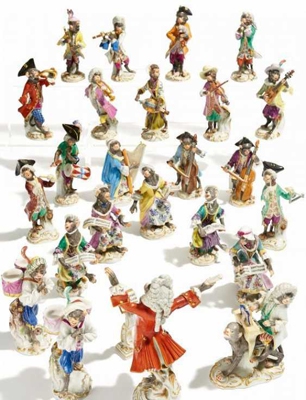 The traditional circle of customers of the porcelain manufactory included the richest families in Europe and Russia. More than 40 percent of all Meissen products went to Russia. Elizaveta Petrovna - adored the manufactory's porcelain. Andreevsky and Elizavetinsky sets were made for her. For Catherine II, a hunting service was made, consisting of 1000 individual items, the second most luxurious service of the 18th century. Among the customers were many crowned heads of Europe and European nobility. For example, Madame de Pompadour's collection contained more than 400 items of manufacture, including Kendler's famous "monkey orchestra", consisting of 21 statuettes of monkeys in court costumes playing musical instruments.
Meissen production flourished, but the secret of production was never preserved. The most famous manufactories in Germany - Hoechst, Nymphenburg, Fürstenberg, Frankenthal, Ludwigsburg, Wallendorf - were already in operation by the end of the 18th century. The history of the leading porcelain manufactories later became a model for many generations of masters, painters and sculptors. Porcelain factories in Germany continued to open up until the 20th century. Products of Rosenthal, Fraureut, Hutchenreuther, Allah occupy a worthy place among the works of porcelain art.
Austria
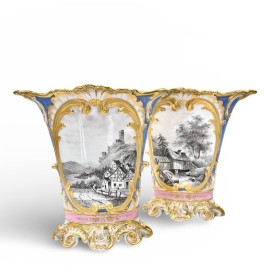
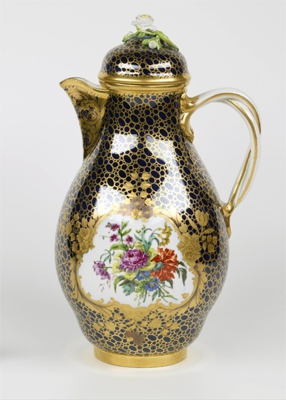 At the time when the Meissen Porcelain Factory had already achieved creative success, they achieved their own style of expression at the second European porcelain manufactory, founded in Vienna in 1718. The Viennese manufactory was under the patronage of the imperial house, it was created at its expense, and it was not chemists-technologists who worked to reveal the secret of the porcelain recipe, but the imperial spies who stole the porcelain recipe used the information of the technologist S. Stelzel and the painter G. Gunger who had escaped from the Meissen manufactory. The Austrian emperor Charles VI granted Claudius du Poquier the right to monopoly the production of porcelain in the empire. Since the production of porcelain was under the patronage of the court, the assortment, style and design met the requirements of fashion for luxury and wealth. During this era, Vienna was limited to making dishes and painting them. The decor was first inspired by Japanese Imari porcelain. In the 1740s, rococo features appeared in the decor - lattice wicker, leafy shoots, shells, flowers, fruits or landscape paintings in cartouches. Vienna's porcelain sculpture is distinguished by its special character. Grace, liveliness of movements, and a special type of small heads with a thin, smiling mouth are characteristic of compositions on allegorical and mythological subjects.
Charles VI was succeeded by Empress Maria Theresa. The manufactory was sold in favor of the state and became known as the "Imperial State Manufactory of Vienna", and the products began to be marked with the stamp with the coat of arms of the ruling Babenberg dynasty.
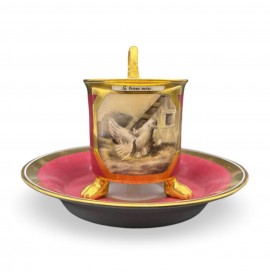
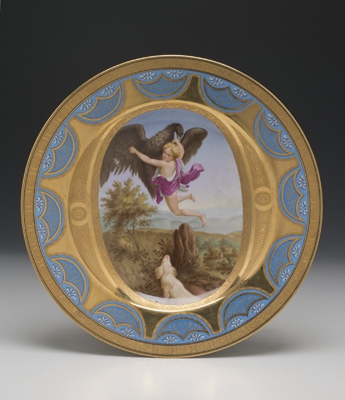 With the arrival of a new director at the manufactory - Konrad von Zongenthal, the manufactory became a leader in European manufacturers. The painters of the manufactory began to receive a professional academic education, which made it possible to transfer to a small space of plates, cups and vases not schematic, colored reproductions of engravings, but full-fledged academic copies of great works of painting. The ubiquitous fashion for "porcelain galleries", picked up everywhere, led to the fact that by the middle of the 19th century, probably, the entire artistic heritage of Europe was reproduced on dishes and interior decoration items.
France
In France, porcelain began to be produced in 1740 in Vincent with the support of Louis XV and Madame de Pompadour. At the beginning of its activity, the factory, according to the decree of Louis XV, sought to "make porcelain according to the model of Saxony, painted and gilded, as well as images of human figures." The imitation of the Meissen style, which served as a model for the emerging European manufactories, continued until 1753. However, in parallel with this, French masters are beginning to look for their own "face", relying on the properties of a soft "paste" with great plasticity and expressive texture.
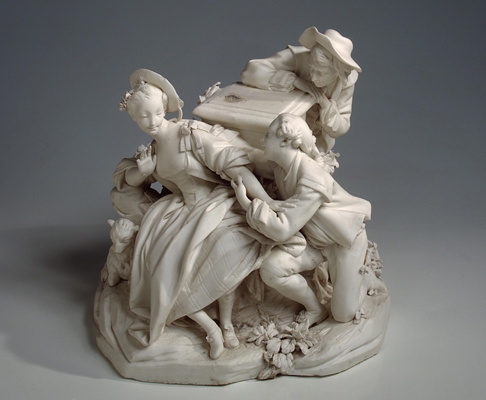 In 1751, the artist and sculptor Jean-Jacques Bachelier, who was responsible for painting and glazing products, first tried to leave the sculptural groups intact after the first so-called biscuit firing. The figurines were reminiscent of marble with their delicate texture and warm creamy shade. They required great skill and elaboration of the smallest details, since neither glaze nor painting hid surface defects, and expressiveness was achieved only due to the play of light and shade. This is how the world-famous Sevres biscuit plastic appeared. The French aristocracy highly appreciated the novelty, despite the high cost and difficulty in care. Later, many manufacturers of thin-walled ceramics began to use biscuit decor, in particular the English factories Wedgwood and Minton.
In the field of plastic art, it is worth mentioning imitations of colors painted in naturalistic tones, which produce an illusory impression. This was achieved thanks to the special plasticity inherent in the "paste", which differed in composition from Meissen porcelain. Louis XV ordered £ 800,000 of porcelain flowers, which were then used to decorate the conservatory and the rooms in the chambers of the Marquise de Pompadour, whose patronage was the manufacture. With her money, experiments with colored glazes were conducted, which in the future brought the manufacture worldwide fame. Enamels were developed in bright, juicy shades that did not burn out during firing. These are “royal blue”, “lapis lazuli”, turquoise, sky blue, green and, of course, the famous “pink Pompadour”, named after the royal mistress. There was also a new method of gilding followed by firing at low temperatures, which gave the products both the sophistication and splendor characteristic of the Rococo style.
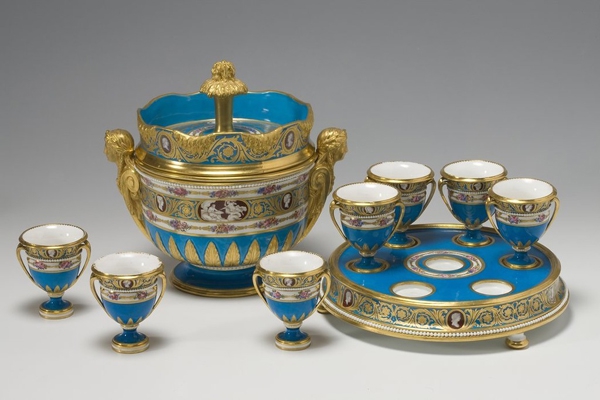 In 1753, the king allowed to put his monogram on Vincennes products - two letters "L" crossed at the bottom and mirrored. This increased the prestige of the factory internationally and attracted the attention of other European monarchs. In particular, the Russian Empress Catherine II ordered the "Cameo Service" for her favorite, Prince Grigory Potemkin. Today, the dining ensemble of a unique turquoise shade of more than 700 items is in the Hermitage along with other masterpieces of Sèvres porcelain. 1756 the factory is transferred to Sevres. It became known as the "Royal French Porcelain Manufactory".
In 1757, Etienne Maurice Falconet became the chief sculptor. And the Rococo style was replaced by the characteristic Sevres emotional and lyrical neoclassicism.
Although the era of the French Revolution was not a favorable time for manufacture, production still did not stop. In the era of Napoleon, Sèvres began to set the tone for European porcelain products. The Empire period began - the forms are reduced to simple schemes, porcelain becomes similar to bronze or stone. The style was distinguished by solemnity and splendor. The decor consisted of ornaments modeled on the patterns of Pompeii, frescoes by Raphael.
The period 1852-1870 as applied to the Sevres style is called the "second Empire". It is just as solemnly pompous, but the style is smoother.
By 1850, Sevres had also developed a technique called pate-sur-pâte -
literally "paste on paste" - building up layers of white liquid clay on colored substrates - creating translucent and transparent effects.
The search for new technical and artistic methods continues to this day at the Sevres manufactory.
England
Many of the most beautiful examples of English XVIII century. appeared thanks to the passion of the British for tea drinking, which became fashionable after the Restoration, around 1660. From the beginning of the 17th century. Ships of the East India Company, loaded with Chinese hard porcelain tea sets, regularly called at the ports of England. The rough products of local potters could not compete with the exquisite tea sets in China, so in England feverish experiments with porcelain began in the hope of learning how to copy Chinese, and then continental porcelain that began to appear on the English market.
By the middle of the 18th century, the manufactories of Bau, Chelsea, Worcester, Derby, and others began to make porcelain.
Bau's products are distinguished by their imitation of Meissen and Chinese designs. In the painting of the dishes, "German" flowers were used in combination with the "kakiymon" pattern and Chinese floral motifs..
Chelsea's works were very diverse, and the sources of borrowing were varied: forms and decor in the style of kakiymon and imari ascend to the East, to Meissen - painted decor and figured plastic, to Sevres - dish forms with favorite pictures by Boucher and Watteau and backgrounds of blue, turquoise, aqua, yellow and red colors.
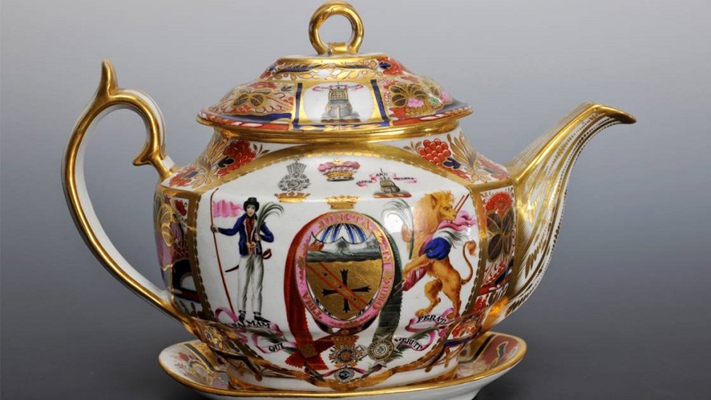 The Worcester Porcelain Factory produced products that met high standards of aesthetics and quality. By 1770, the famous Chelsea factory had joined the company. The manufactory attracted the attention of King George III, who in 1788 awarded it the prestigious status of "royal". The porcelain figurines made in the second half of the 18th century are famous all over the world for their refinement and elegance. No less fame was brought to the plant by luxurious sets, original mugs, the thinnest bone china cups and other dishes, the quality of which has been improving more and more from year to year.
 The Derby factory flourished thanks to the production of high quality porcelain figures and vases, with floral painting and Japanese imari motifs.
In 1750, the hereditary potter J. Wedgwood founded the porcelain industry.
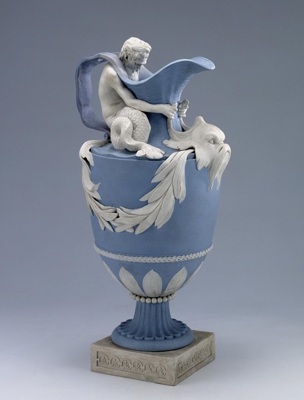 J. Wedgwood made a huge contribution to the development of English porcelain. In 1774, he invented a special kind of fine unglazed porcelain called Jasper, reminiscent of old biscuits.
 В 1773 году Екатерина II приобрела знаменитый «Сервиз с зеленой лягушкой» для Чесменского дворца, который тогда называли «Дворец на лягушачьем болоте». Этот уникальный сервиз ручной росписи состоял из 952-х предметов, на каждом из них была изображена лягушка, сервиз украшали 1244 архитектурно-пейзажные вида старой Англии. Сегодня этот сервиз хранится в Эрмитаже, в коллекции английской керамики.
Denmark
Only in 1773, after many fruitless efforts, the production of hard porcelain was established in Copenhagen. Painters from Meissen and fashion designers from Fürstenberg are invited. In addition to large decorative vases, mirror frames and high quality tableware, glazed and biscuit figurines were produced, largely copies of Falcone, Boucher and Assier. Floral motifs, garlands, wreaths and medallions with “en grisaille” heads were used in the painting. Since its inception, the company's logo has been represented by three blue wavy lines representing the three sea straits of Denmark.
In 1790, by order of the future Danish king Frederick VI, the production of the unique Flora Danica service began. The images of all 2600 plant species found in Denmark should have been transferred to it from the famous botanical atlas with the same name. It was so many items that the service was supposed to consist of. It has become a real porcelain herbarium for the kingdom.
It is curious that "Flora Danica" was intended as a gift to the Russian Empress Catherine II.
But Catherine never received this service, since she died in 1796 until it was fully ready.
During its existence, the manufactory experienced both ups and downs. In 1868 the factory passed into private ownership, it was headed by the merchant G.A.Falk.
In 1885, a new technique of painting under glaze was invented, with the help of which it became possible to place entire landscapes and naturalistic images on products. In 1889, such porcelain became an exhibit at the World Exhibition in Paris, won the Grand Prix, after which it gained worldwide fame.
Among other important European factories, mention should be made of the third largest European factory, founded in Venice in 1720 by Giovanni Vezzi, which was closed some time later, in 1727, due to financial problems. In 1743, King Charles III opened a porcelain factory at the Capo di Monte, near Naples. The rich embossed decor with figured motifs is considered typical of the products of this manufactory. Also worth mentioning is the Vinovo porcelain factory near Turin, which was patronized by the royal family of Savva, as well as the production in Doccia near Florence, founded by the Marquis Carlo Ginori in 1735, which is still active today.
Gallery "Vernissage" offers to buy antique figurines and tableware produced by European manufactories. The items presented in the catalog are in perfect condition. If the desired item was not found in the catalog, leave a request and we will help you find it.
Russia
In Russia, the fashion for porcelain is considered to be introduced by Peter I, who, having visited the residence of the King of Prussia Oranienburg in 1712, examined the two chambers there, decorated in the "Chinese style", and was delighted with what he saw. On his instructions, the Chinese room of Monplaisir was created and the first purchases of porcelain were made.
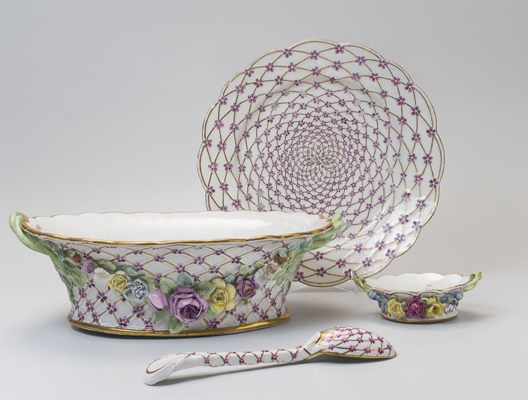 The secret of hard porcelain production was discovered by Lomonosov's associate D.I. Vinogradov in the late 1740s. The manufactory in St. Petersburg, where he worked, eventually turned into the Imperial Porcelain Factory. In the early years, small things were made at the Neva Porcelain Manufactory, mainly snuff boxes for Empress Elizabeth Petrovna, which she, in turn, gave to those close to her and sent them as diplomatic gifts. Since 1756, when Vinogradov managed to build a large forge, they began to make larger items. The creation of the first "Own" service, which belonged to the empress personally, also dates back to this time. With the reign of Catherine the Great, who for artistic purposes invites foreign fashion designers, replacing a significant part of the staff, an artistic upsurge began. The admiration for French culture is also reflected in porcelain production: the influence of Sevres is noticeable in the forms and noble decors of luxurious tableware. The end of the 18th century was the heyday of Russian porcelain, and the Imperial Factory was one of the leading in Europe. The summit of fame of the Imperial Plant was made up of luxurious service ensembles ordered by Catherine II - "Arabesque", "Yakhtinsky", "Kabinetsky", numbering up to a thousand items. The central part of the ensembles was occupied by table sculptural decorations, glorifying the deeds of the empress. Allegorical painting also glorified the virtues of Catherine and reflected the events of her reign. With the approval of the empress, the factory produced a series of sculptures "The Peoples of Russia" (about a hundred figures), further expanded by the types of St. Petersburg industrialists, artisans and street vendors. The plant produced a large assortment of vases. The painting harmoniously combined with the form, emphasizing the whiteness of the porcelain and the warm tone of the shiny glaze.
All subsequent emperors provided the plant with large orders. Russian porcelain of the following eras not so much glorified the deeds of the emperor, but was a reflection of national themes and plots in art, such as, for example, the "Guryev" service, which became an ode to the people - the winner in the Patriotic War of 1812. A special place in the production of the plant was occupied by vases. Gold has become one of the favorite decorative materials. Painting was mainly specific and battle painting. The second most important group of products was made up of palace services. On vases of the Historicism period canvases of old masters were reproduced - Leonardo da Vinci, Raphael, Titian, Correggio, Murillo, etc., mainly from the collection of the Hermitage. The copies were striking in the accuracy and subtlety of the dotted lines. The range of colors, purity and brilliance of the colors were fully adequate to the original. The development of portrait, icon and miniature painting on vases and layers also received. The factory's superiority in porcelain painting was confirmed by receiving diplomas at world exhibitions in London, Paris and Vienna.
During the reign of the last Russian emperor Nicholas II, the plant reached an exemplary state in technical and technological terms. Since the mid-1900s, the plant has established relations with the artists of the "World of Art" association K. Somov, E. Lansere, S. Chekhonin, which contributed to the establishment of neoclassicism.
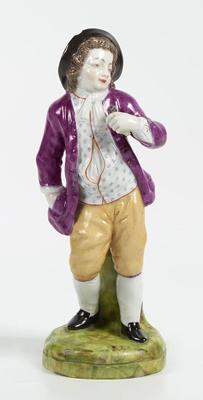 The private porcelain factory of the Englishman Francis Gardner, founded in 1754 in Verbilki near Moscow, competed with the tsarist manufactory for the quality of goods. For 126 years since the opening of the plant, the enterprise has been concentrated in the hands of the founder's descendants.
The factory made four services for Catherine II - Georgievsky, Vladimir, Andrew the First-Called and Alexander Nevsky), and the manufacturer himself was honored to brand his porcelain with the image of the Moscow coat of arms. Each of the services included a huge number of items (up to one and a half thousand). They were used every year for the royal feast meals.
In the works of the floral theme of the painters of the Gardner plant, images of baskets with flowers suspended from ribbons are often traced, borrowed from European masters.
One of the themes for the small plastic arts of the plant was the Russian theme, which showed a new country inhabited by people of simple professions. A series of sculptures "The Magic Lantern" was created on this theme, which is replete with figurines of peasants, janitors, lackeys and other ordinary people.
In 1891, Gardner's heirs sold it to Matvey Kuznetsov, who added the enterprise to his piggy bank of porcelain manufactories, of which he already had four by that time: Riga Porcelain and Faience Factory (1841), Dulevo Porcelain Factory (1832), Auerbach Porcelain Factory (1870) and the Budyansk faience factory (1887).
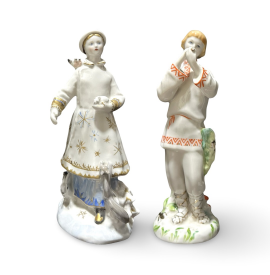
Competition to Gardner was the Popov factory, founded in 1804 by the former commission agent of the Gardner factory, Carlo Melli, who sold it to the merchant of the first guild A. Popov. The products produced were very diverse. The factory produced both expensive custom-made sets and simple dishes for people of middle and low income. In addition to a variety of tableware, these were sculptures, vases and various porcelain items for the home. However, in addition to such a product, the factory produced art items of extraordinary beauty. Perhaps we can say that the porcelain figurines of priest's mowers, spinners, shepherds, fashionistas and fashionistas, the series of the Neapolitan puppet theater with Columbine and Pantalone are not only comparable to the figurines of the Imperial Porcelain Factory, but somewhere they surpass them in grace and subtlety of painting. The subtlety of underglaze and overglaze painting, which is rare for Russian products, inherent in priest's porcelain figurines, puts them on a par with similar products of the famous Meissen.
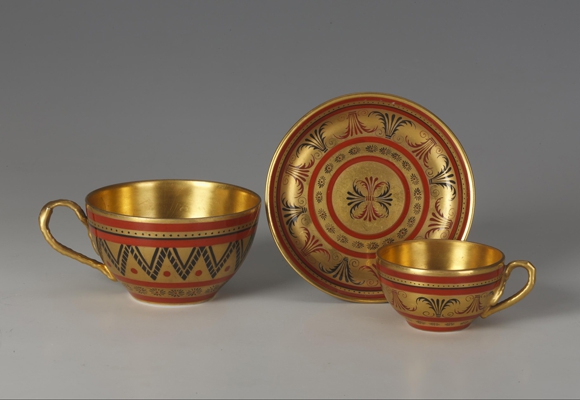 In 1832, the Kuznetsov factory began operating in Dulevo, and after a few decades this factory became the leading porcelain manufacturer in Russia. The porcelain of the factory was distinguished by noble simplicity - dazzling whiteness was combined with magnificent gilding and a uniform, rich glaze of glaze. The emphasis in the products was placed on originality, and the masters working at the Dulevo manufactory learned from the Gzhel craftsmen, using exclusively hand-painted painting in their work.
In 1887, the “MS Kuznetsov's Partnership for the Production of Porcelain, Earthenware and Majolica Products” was founded. In the later stages, it included eight enterprises that brought 2/3 of the income from the entire porcelain and faience industry in Russia. At the turn of the century, the Partnership received prizes at international exhibitions in Europe and earned the status of a supplier to the imperial court.
By visiting the Vernissage gallery, you can get acquainted with interesting objects, trace the history of the development of styles and buy Russian porcelain of various brands.